

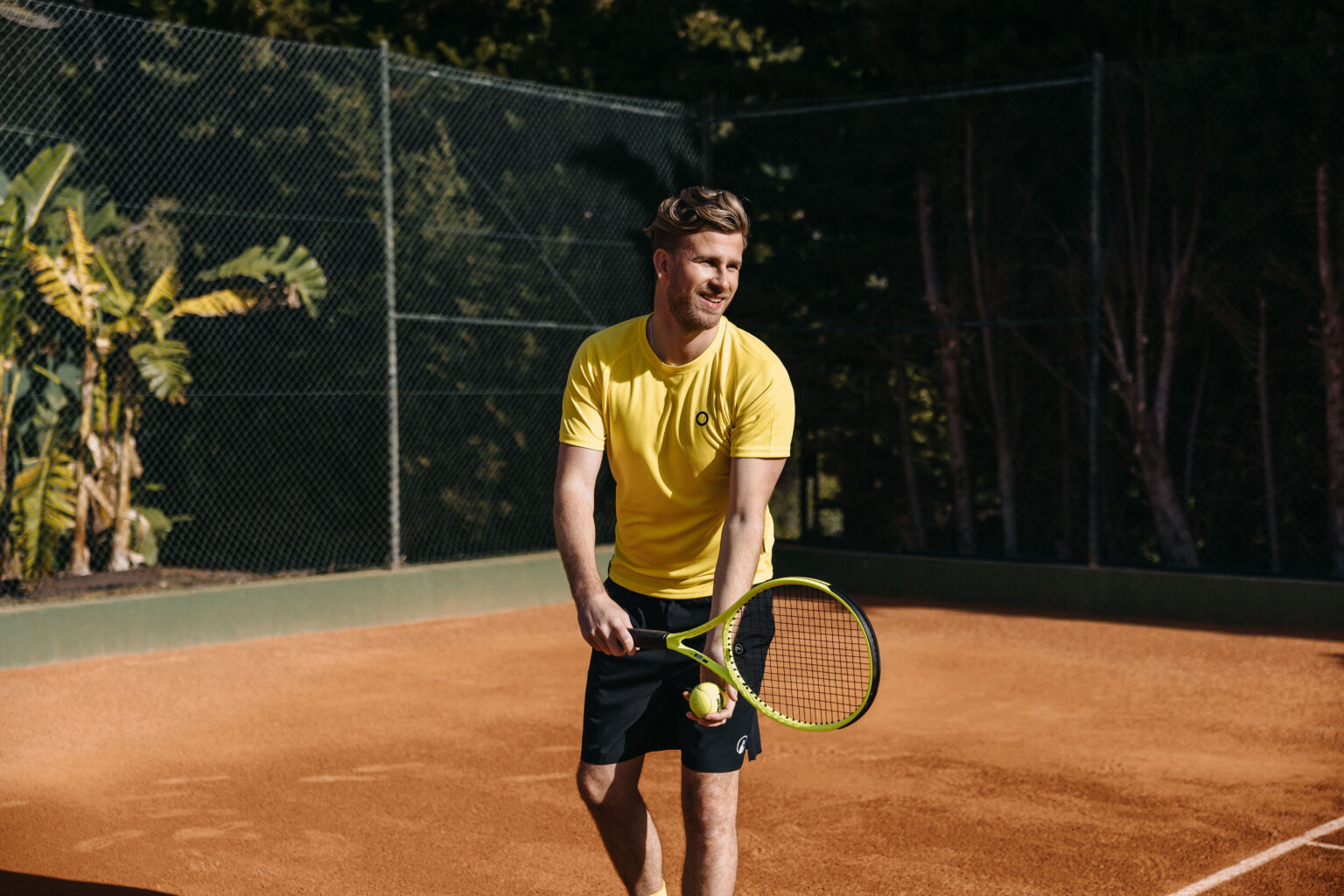
The serve is an important key to a successful match. Even if the rule that a break decides the set does not necessarily apply to club players, the serve should still be a noticeable advantage. Even if direct points in the form of aces are the exception on clay, an effective service is an important building block of your game. Good servers also have the edge in doubles.
Here are five tips to effectively improve your serve.
The feet are the key to a powerful serve
If you walk from court to court during the points matches in the clubs, one thing always catches your eye: a very large proportion of all team players overstep massively when serving, which is actually a mistake that is punished with the loss of points. However, most of them allow this permanent error as a trivial offense and only complain about it in exceptional cases.
The bad thing about this is not actually the violation of the rules, although this should also be stopped. The violation indicates that the server is doing things with his feet during his serve that are definitely not intended. And that is fatal for the serve. Because a precise, powerful serve requires a stable foot position. After all, power also comes from the legs and body tension. Both can only develop if the base is right – i.e. the feet are not uncontrollably jostling around on the ground.
If you are also a foot fault producer, you should work on this as soon as possible.
It’s best if one of your teammates films you serving. That way you can see what your feet are doing incorrectly during the service.
The best way to break the habit is to grab a well-filled bucket of balls and go for a hit. Make sure you keep your feet behind the line. The front foot (the left foot for right-handers) remains fixed during the serve, the second foot is pulled towards the front foot during the stretching phase of the body. With the swing and after the shot, the standing foot goes into the court in a controlled manner in order to launch straight through to the net if necessary.
Concentrate on stabilizing your feet and have yourself filmed again when you think you are stable. You will definitely notice that your serve becomes both more precise and faster as soon as you have eliminated the foot dilemma.
The ball throw: the only thing that helps is practise, practise, practise
Another phenomenon that can often be observed in club players is the unsuccessful and repeated ball throw before the serve. Let's remember our tennis school days: the ball for a straight serve should land about one racket length and in the direction of the front tip of the shoe after it has been thrown in the normal way. Unfortunately, a lot of serves are hit even though the throw was not good. We then have the right to repeat the throw. But of course it's also embarrassing to ask your opponent to apologize three times because you have to “rethrow” so often. A good, safe ball throw is purely a matter of training - the throw can also be practiced well in the garden or on the terrace.
Sports scientists believe that a movement must be repeated several thousand times for the body to memorize the movement and automatically perform it correctly from then on. This means: practise, practise, practise until the throw is “right”.
The second serve: underestimated in its importance by most players
A lot of players have a passable first serve, but they hit the second into the court as a so-called “pancake serve”. The name comes from the fact that the second service is pushed into the opponent's service court in a high trajectory, rather like a shuttlecock. This usually results in hard returns by the opponent, giving them a clear advantage for the following rally. The second serve should be a variation of the first, which is played with an edge for safety.
A second serve with a slice, i.e. sideways rotation, is easy to learn. You can practise this very well on your own. The grip has to be changed slightly and the ball is thrown more to the right (for right-handers) compared to the straight serve.
When practicing, you will find that you can play this variation at the same speed as the straight first serve. Nevertheless, it is safer and slightly slower because half of the acceleration goes into the cut. Practice this serve until it is really safe. And get into the habit of actually playing it in matches. Even if you initially make a few more double faults due to insecurity, stick with the slice variant, as you will benefit massively from a confident second serve with slice in the further course of your tennis career.


Is the kick serve reserved for professionals?
It's safe, flies high over the net and bounces high: the kick serve is the mother of all second serves. But in club circles you only see it occasionally. Yet anyone with a reasonably clean technical serve can add the kick serve to their repertoire with a little hard work (and additional tips from their coach). It is perfectly feasible to add forward spin to the serve by changing the toss and racket control.
To get an idea of how the kick serve works, we recommend the following initial exercise: You place a towel or other surface on the spot from which you normally serve. Now kneel on the pad in the direction of the net post. Now try to throw a ball up to serve in this position and then get the ball over the net into the correct service area. You will only be able to do this if you execute approximately the racket movement that will later form the basis for your kick serve. Don't despair, the first balls will probably land on your side of the net because the movement is indeed very unfamiliar. But it is a good start to a new era of serving that will noticeably enrich your game.